
Rubrics
A rubric is a guide to help score the quality of an assignment. Rubrics contain a set of criteria necessary for grading an assignment.
Rubrics help the learner and instructor by providing them with:
- an overview of what will be graded,
- consistent grading, and
- the expectations for grading.
Generally, a rubric is presented in a table format and can be used by both the instructor for grading, and by the learners for planning their work. A rubric is designed to communicate expectations of the task at hand to both the learner and the instructor.
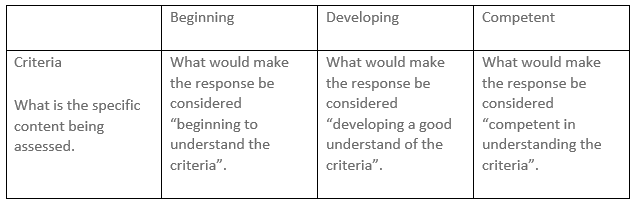
Above is a sample template that can be
used to start a rubric. See “Resources” below to get a more detailed
sample.
The two main components of a rubric are
the criteria being assessed and the levels at which the criteria can be
graded.
Criteria are specific and detailed
components of the overall assignment that you are looking at. This breaks
down a larger assignment into smaller pieces. These pieces are typically
the things that you would consider and look for when grading an assignment to
verify completeness and that it met your desired outcomes. There is no
minimum or maximum number of criteria. The more complex the assignment
and the more specific details you are wanting, the more criteria that would be
graded.
Levels will offer a variety of options
that start at a more basic point and go to a more detailed response. Most
rubrics will have 3 or 4 Levels, however, when creating a rubric you can use as
many levels as preferred, they can also be labeled in any preferred
terminology. For our example we label them at “Beginning”, “Developing”,
and “Competent”
Below is a sample of part of a grading
rubric.
Training:
Using Observations to Create Lesson Plans
Final Assignment:
Observe a classroom of your choice. Make notes of the observation/use
observation forms. Based on the observation create a lesson plan using
the attached template.
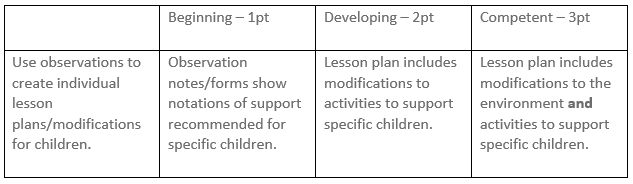
When grading, each level is assigned
points. Once again, the points assigned are subjective, but should be
uniform across the entire rubric. Depending on the total number of points
possible, you would determine how many points a participant would need in order
to pass the assignment, a recommended guide would be getting 80% of the
possible number of points.
Benefits of rubrics for trainers:
- Provide learners with clear instructions for desired outcomes
- Provide reliability and consistency in evaluating learner assessments
- Provide justification for course completion and credit obtainment
- Allow for reliability and consistency in scoring
For the learner the rubric can be of benefit because:
- Provide clear instructions of expectations
- Show possible variations in the grading
- Provide feedback on the quality of work
Resources
Below is a rubric example
The document above is also included in the appendix of your course handout. Download this if you’d prefer a separate version.