
Topic 8.6: Step 4: Plan lessons and maximize student involvement
Maya: Now we are ready to plan lessons and maximize student involvement. How do we make sure communication supports show up during real classroom activities, not just during isolated practice?

Calvin: In this section, we will think about the communication partners students interact with across school, home, and community life. Then we will return to the SETT Framework to plan communication supports across environments, tasks, and tools. We will also look at peer-mediated strategies that help students participate more fully with classmates.
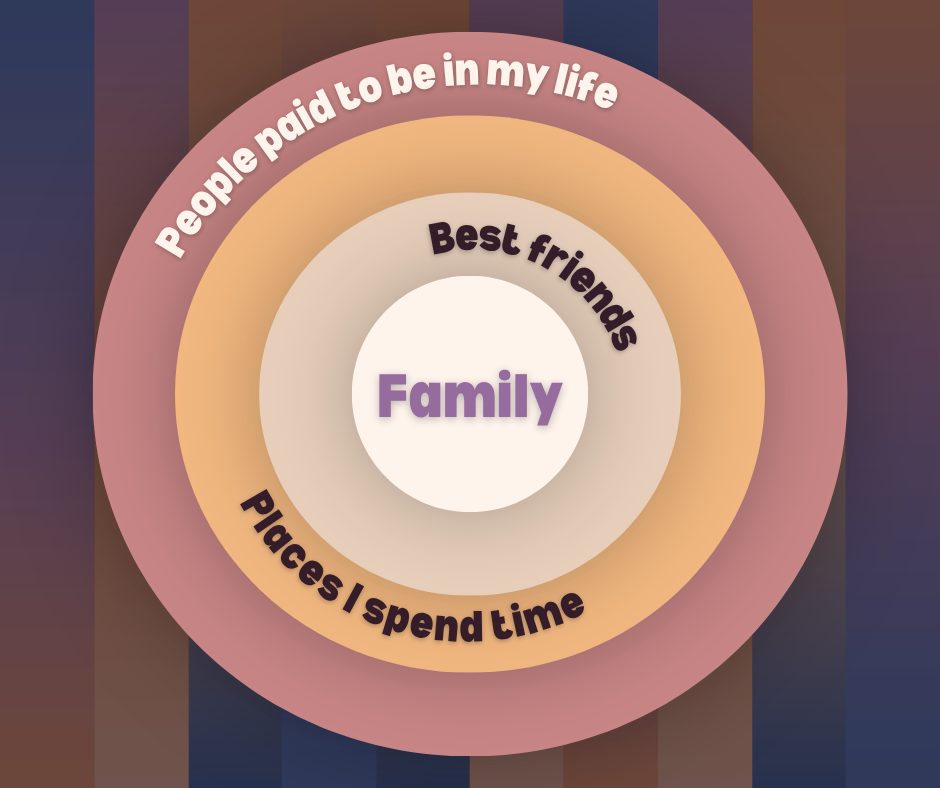
Maya: This circle graphic reminds me that students have different kinds of communication partners. Some people are close family or friends. Others are classmates, community members, school staff, or people paid to provide support.
Calvin: For communication planning, we can use the circles to ask how communication changes across partners. A student may communicate with family through familiar gestures, use AAC with classmates, and need additional supports with less familiar communication partners. Communication often becomes more complex as we move farther out from the people who know the student best.
Maya: As teams plan, these questions can help them think about communication partners and AAC across different settings.
Calvin: Next, use the SETT Framework to identify the environments, tasks, and tools that will help the student participate and communicate across the day.
Maya: This is where each team member’s expertise matters. The team can problem-solve what the student needs for access, engagement, and participation in the classroom and other school-related activities.
Calvin: Respect others’ opinions and have high expectations
Collect effectiveness data
Quickly address problems- Don’t settle for “It just doesn’t work” or “We’ve tried that”
The SETT Framework – Environment Task Tool (Zabala, 2005)
| Environment | Task | Tool |
|---|---|---|
| Morning Routine | Greeting friends | Switch with greeting |
| Reading | Answer reading questions | Partner assisted scanning with yes/no |
| Writing | Make plan for an activity | ? |
| Recess | Conversation with friends | Recorded activity on switch and Partner assisted scanning |
| Math Vocabulary | Math problems adding 1 | Numbers in high contrast, colors on black background. Symbols add and more. |
| Science | Describe chemical reaction | High contrast symbols/words for measure, pour, add, bubbles, comment word – wow |
Calvin: This is an example of some of the environments, tasks and tools for a specific student. The team answered the following questions to think through this form:
- In what environments does the student participate?
- What tasks are required in each environment?
- HOW will the students communicate in each environment to meet the needs of each setting and fully participate?
Maximizing Student Participation with Peers
| What are the differences? | Peer Networks | Peer Support Arrangements |
|---|---|---|
| What is the focus? | Social interactions and friendships | Classroom engagement, learning, and social interactions |
| How many peers? | 3-6 peers | 2-3 peers |
| Who facilitates? | Any school staff or a community member | Paraprofessional, special educator, classroom teacher |
| When do they meet? | Weekly for about 30 minutes – during lunch, advisory, clubs, and other non-instructional times | Every class period for the entire class in the general education classroom |
| “How to Modules” YouTube links | A Guide to Implementing Peer Network Interventions | A Guide to Implementing Peer Support Arrangements |
Calvin: One effective way to maximize student participation and increase communicative competence is through the implementation of evidence-based, peer-mediated strategies.
Peer networks and peer support arrangements are two practical, evidence-based approaches for supporting inclusive learning opportunities for students with significant disabilities and complex communication needs.
These Peer support strategies are designed to increase communication opportunities and decrease reliance on adult-delivered supports by creating well-supported, inclusive activities. In contrast to one-to-one paraprofessional support models, students with significant disabilities come to receive most (though certainly not all) of their assistance from their peers, this can be classmates, co-workers, teammates, etc.. And the students are all part of a community of learners—drawing each other into learning.
To learn more about implementing these two strategies, you can view two short modules from the KYPeerSupportProject website. Links to the modules are included on this slide and can be found in the resources section of your workbook.
Maya: Calvin, I hadn’t really thought about how much a student’s opportunities to interact with peers can vary. Aren’t students all together at school most of the day?
Calvin: Not always. Even in schools that have inclusive classrooms and clubs, there can still be separate classrooms, activities, or routines that limit interaction. Students with and without disabilities may be in the same school, but they don’t always have meaningful opportunities to spend time together.
Maya: So, being in the same building doesn’t automatically mean students are building relationships?
Calvin: Exactly. Think about lunch. Students may be in the same cafeteria but sit at different tables. Or they may attend physical education or electives together but be separated during core academic classes.
Maya: That makes sense. If students aren’t actually together, it’s hard to create friendships.
Calvin: Right. Research supports that idea. In studies of inclusive classrooms, students with significant disabilities spent a lot of time without classmates nearby. In elementary schools, students were not in close proximity to peers during about 41% of class time. In high schools, that number increased to 58%.
Maya: Wow. What was happening during that time?
Calvin: Sometimes students were sitting next to a paraprofessional instead of peers. Other times they were working at a separate table, grouped with other students with disabilities, or temporarily out of the classroom.
Maya: And if students aren’t near each other, they can’t really talk or work together.
Calvin: Exactly. Communication and relationships require opportunities for interaction.
Maya: What about students who use AAC?
Calvin: There’s another challenge there. Studies found that AAC devices were not within easy reach of students for nearly 60% of the class period. If the communication system isn’t available, communication opportunities are lost.
Maya: So when we’re designing AAC systems, we have to think beyond academics.
Calvin: Absolutely. We should design communication systems with peers in mind. A student’s primary communication partners should be their classmates and friends, not just adults.
Maya: That means including vocabulary students actually want to use with each other.
Calvin: Exactly. Students need words for social interactions, jokes, opinions, shared interests, and everyday conversations. Academic vocabulary is important, but it’s only one part of communication.
Maya: That’s where core vocabulary becomes so valuable, right?
Calvin: Yes. Core words are flexible and can be used across many activities, settings, and conversations. They help students say a lot of different things throughout the day.